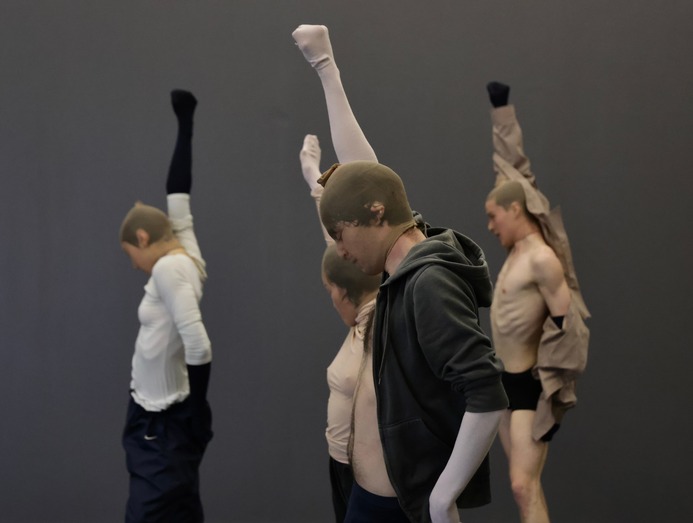
She danced at the Paris Opera from 1981 to 1988, performing both classical repertoire and works by Balanchine, Limón, and Cunningham, and participating in creations by Alvin Ailey, Maguy Marin, and Bob Wilson. In 1988, she joined the company of Dominique Bagouet, and after his death in 1992, she co-founded Les Carnets Bagouet to preserve and pass on his legacy.
Her work blends disciplines and tackles complex, sometimes divisive subjects, such as Lettrism and Isidore Isou in Le Cabaret discrépant (2011), John Cage’s Ryoanji translated into dance (2012), and a homage to Native American cultures in À l’Ouest (2018).
Equally at ease with solo works and large ensemble pieces, she consistently weaves connections between text and choreography. From 2011, she was based in Nantes and became an associate artist at Le Lieu Unique (2017–2022), where she developed participatory formats such as Koréoké (a choreographic karaoke) and the concept of “choreographic operations theatre” (Le Dance-Park, 2019, with Yves Godin).
She has led large-scale projects, including Jour de colère (2019) with twenty-one dancers from the Ballet de Lorraine, and initiated research on utopias, leading to Nous vaincrons les maléfices (2020). In 2022, she took over the direction of the National Choreographic Centre in La Rochelle, which she renamed Mille Plateaux. In 2024, she created UMAA (Mobile Unit for Artistic Action), a travelling, serial, multidisciplinary work.